Assembly Orders
When adding an item to an assembly order, the default view doesn't immediately show the stock position on the screen. Hence, we've developed the availability indicators for the Item line type.
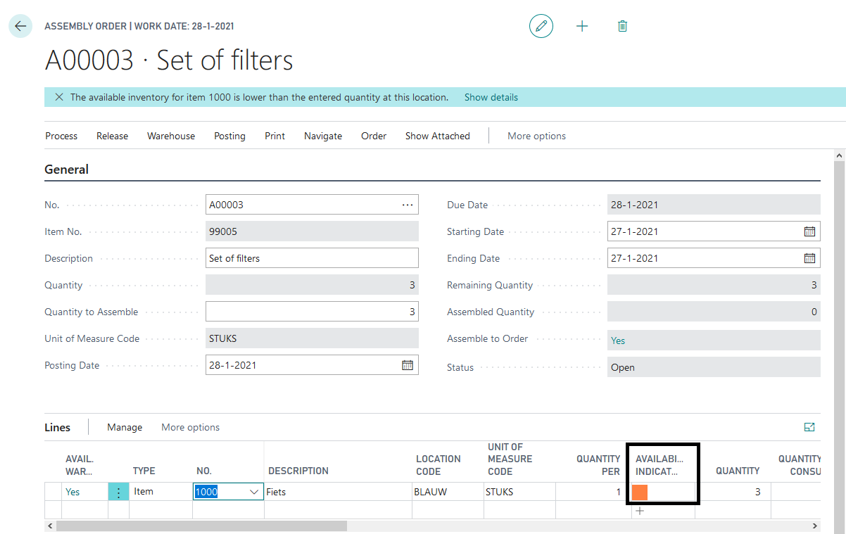
-
 None/White
The order line is completely consumed. There is nothing to consume.
-
 Orange
There is no inventory but the sum of the supply lines (Qty. on Purch. Order + Qty. on Assembly Order + Trans. Ord. Receipt (Qty.) + Qty. on Sales Return + Qty. on Prod. Order) is similar to or larger than the quantity of the demand lines.
-
 Green
GreenThe quantity on stock is sufficient for the open demand lines. The calculation for the green indicator is: Sum of all demand lines (Qty. on Sales Order + Qty. on Purch. Return + Qty. on Component Lines + Qty. on Asm. Component + Trans. Ord. Shipment (Qty.) + Qty. on Service Order) is smaller than the Inventory.
-
 Red
RedThere is no inventory to fulfill the need in demand lines. There are also no supply lines to fulfill in this needs.
-
 Red/Green
Sum of all demand lines (Qty. on Sales Order + Qty. on Purch. Return + Qty. on Component Lines + Qty. on Asm. Component + Trans. Ord. Shipment (Qty.) + Qty. on Service Order) is bigger than the Inventory, but there is some inventory available to ship or consume and not enough available in the supply lines (Qty. on Purch. Order + Qty. on Assembly Order + Trans. Ord. Receipt (Qty.) + Qty. on Sales Return + Qty. on Prod. Order) to fulfill in the total needs.
-
 Orange/Green
Sum of all demand lines (Qty. on Sales Order + Qty. on Purch. Return + Qty. on Component Lines + Qty. on Asm. Component + Trans. Ord. Shipment (Qty.) + Qty. on Service Order) is larger than the Inventory, but there is some inventory available to ship and enough available in the supply lines (Qty. on Purch. Order + Qty. on Assembly Order + Trans. Ord. Receipt (Qty.) + Qty. on Sales Return + Qty. on Prod. Order) to fulfill in the needs for all the demand lines.